
Two graphic design proposals might each promise “three designs” while describing very different work. One provider may mean three creative directions. Another may mean one concept adapted for a poster, a social post and an invitation. Before comparing prices, establish what each proposal is counting.
Review six areas: the purpose of the work, concepts and adaptations, feedback rounds, content and production responsibilities, deliverable files, and the schedule and pricing model. If you are still defining the role of the designer, start with the decisions involved in graphic design. A useful quote shows which of those decisions and outputs your project includes.
1. State the Need Each Proposal Must Address
“We want a professional design” leaves too much open. Are you announcing a new product, bringing inconsistent materials into line, or replacing documents used by the sales team? Each goal changes the work required before anyone starts arranging a layout.
Imagine an event announcement that needs a poster, square social post and vertical story. Share the audience, main message, distribution channels and available brand assets. Give each provider the same starting information. Asking one designer for a poster and another for a campaign concept will not produce comparable totals.
AIGA’s proposal guidance emphasizes a visible purpose, scope, client inputs and deliverables. For a buyer, the practical question is which assumptions the provider has made about anything you have not yet decided.
2. Separate Concepts, Adaptations and File Exports
A creative direction is the underlying idea and visual approach. An adaptation applies the chosen approach to another size, channel or content requirement. An export is a delivered file, such as a PDF or PNG. Exporting one layout in two formats does not establish that two original concepts were developed.
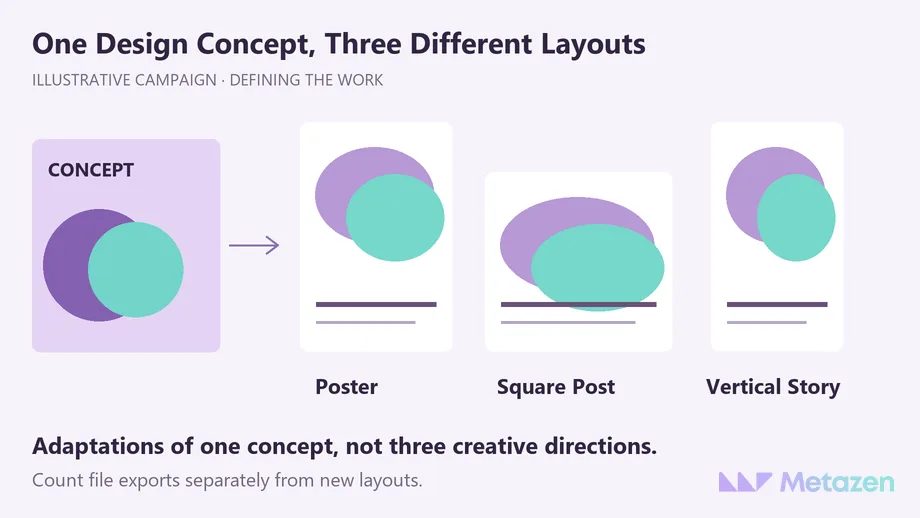
A date, location and description that fit comfortably on a poster may need a different order in a vertical story. The headline might need shortening and the photo may need a new crop. Adapting the work can involve more than resizing it. List the required dimensions, languages and product variants in the proposal.
Illustrator’s export tools can create multiple formats and scales from the same asset. Ask which layouts will be designed and how each one will be supplied.
3. Agree Where Revisions End and New Work Begins
If a proposal includes “two revisions,” ask how they work. Does a round mean one consolidated set of feedback from your team? Is every small comment counted separately? What happens if you select a direction at the first presentation and later request a completely different idea?
For the event announcement, changing the date is different from replacing an approved typographic layout with a new illustration-led concept. Discuss which changes fit the agreed scope and which need a revised fee or schedule. There is no single revision allowance that should be treated as standard for every design project.
Consolidate feedback. Have one person reconcile comments from marketing, sales and management. If one stakeholder approves a headline and another rejects it the following day, the decision process needs attention as well as the artwork.
4. Identify Who Provides Content and Pays for Production
Are the copy, photographs and product details ready to use? Will the designer be expected to retouch images, shorten text, arrange translations or organize photography? Saying “we will provide the assets” while the files still need to be created gives the provider an unreliable basis for estimating time and cost.
For a restaurant menu, the business might verify item names and prices while the designer handles the layout. If photography is required, include the shoot and image selection in the agreed work. Do not assume that a design service automatically supplies every missing piece of content.
Preparing a print PDF and delivering a box of printed materials are different services. InDesign’s print PDF export prepares a file; it does not purchase paper, finishing or shipping. For the distinction between proofing and production responsibilities, see the stages of a print design project.
5. Specify Files and Usage Expectations Before Handoff
Do you only need finished assets to publish, or will your in-house team edit the text and images later? If editing matters, discuss source files, the application needed to open them and any linked assets before accepting the quote. “Source file included” does not explain every dependency the next designer may encounter.
Adobe’s Illustrator packaging documentation covers linked graphics and fonts alongside the working document. Whether those assets can be shared depends on their licenses. Receiving the design file does not automatically grant unrestricted use of everything placed inside it.
Do not assume fonts can be bundled. Adobe Fonts explains that a client who directly edits with a font needs their own license. Distinguish that requirement from receiving a correctly embedded PDF or image. Other font providers may have different terms.
6. Connect the Schedule and Fee to the Agreed Work
A start date, first presentation, feedback window and final handoff are separate milestones. Ask which dates depend on receiving your materials or approval. “Delivery in one week” is incomplete if neither side has established when the week begins.
For a project fee, check the included work and how additions are agreed. For hourly pricing, ask for an estimate, a record of work and an approval limit. Compare payment milestones, applicable taxes, third-party expenses and any production costs under the terms of each proposal. The objective is a comparable total for your scope, rather than a supposedly universal rate.
The fictional proposals below describe different work for the same event. Prices are deliberately omitted: until the required scope is aligned, the table cannot tell you which offer would be more economical.
| Scope Item | Proposal A | Proposal B |
|---|---|---|
| Creative direction | One visual direction | A choice between two directions |
| Adaptations | Poster layout | Poster, square post and vertical story |
| Feedback | One consolidated round | Two consolidated rounds |
| Content inputs | Approved copy and photos supplied by the client | Shortening supplied copy included; photos supplied by the client |
| Handoff | Print PDF | Print PDF, digital exports and specified source files |
| Physical production | Printing and shipping excluded | Printing and shipping excluded |
If you only need a poster, the extra adaptations in Proposal B may add little value. If the announcement will run across several channels, ask what must be added to Proposal A before comparing the price. Neither a longer service list nor a lower total makes the decision on its own.
Let’s Define the Design Work You Need
At Metazen, we organize design discussions around where the work will be used, the adaptations required and the expected handoff. Bring your existing brand assets, message and unresolved questions to our design team. Explore our graphic design services to see how we can plan the work around your requirements.

