
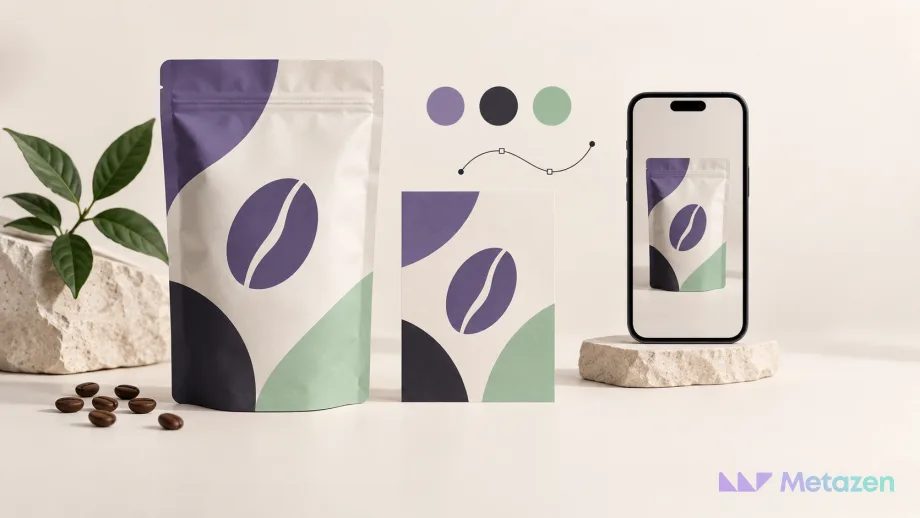
Reading a coffee name on a pouch, finding the time of a tasting on a printed card and recognising the same business on a phone are different tasks. Matching colours can connect the materials, but each surface carries a different message. Graphic design determines how that message becomes clear.
What Does Graphic Design Mean?
Graphic design communicates a message through type, images, colour and layout. A logo, package, poster, catalogue or digital advertisement can be an output. Appearance is part of the job; the design must communicate who is speaking, what they offer and which information to read first.
A product photo, name and price may be enough to convey an offer. Give them equal prominence, crowd them together and add a busy background, and finding the price can become difficult. A designer can make the information easier to follow by changing its arrangement without changing the offer.
What Decisions Does a Graphic Designer Make?
The work begins with understanding the audience, the setting and the information to communicate. A designer then considers what should stand out, which elements belong together and whether the result works at its intended size.
- Information priority: In what order should someone notice an event’s name, date and location?
- Typography: Do the typeface, text size and line spacing make reading comfortable?
- Images and colour: Does the photograph represent the product accurately, and can the text be distinguished from its background?
- Layout: Are related details grouped together, with enough space to read them?
Typography concerns how written text is arranged visually. The coffee name and brewing instructions need not have equal prominence. Someone can identify the product first, then read how to prepare it.
Review the design at its intended size. A date that is easy to read in an enlarged artwork may disappear on a phone screen. Review a small-screen version as well as the enlarged artwork.
3 Graphic Design Examples for a Business
Imagine a business selling its own coffee. The following examples separate three communication tasks; they are hypothetical, with no claimed client results.
1. Visual Identity: Recognising the Same Business
If the pouch, shop card and social profile appear unrelated, a customer may struggle to recognise the business across them. Consistent use of a logo, colours and typography connects the materials. They need not look identical: a small profile image may use a simple mark while a package allows a fuller composition.
A logo is one part of visual identity. It does not decide which typefaces to use, how coffee varieties should be distinguished or how a poster should be laid out. An identity system addresses how the elements work together across different settings. For a practical starting sequence, explore the five steps to building a usable brand identity.
2. Printed Materials: Reading Information in Hand
A coffee pouch may prioritise the variety and brewing information. A tasting card needs a clear location and time. Placing the same large logo on both does not solve both tasks. The pouch is examined on a shelf and in hand; the card lets visitors take the event details away.
If coffee varieties differ only by colour, clear written names give readers another way to distinguish them. Someone who cannot tell the colours apart can identify the product from its label. For a multipage catalogue, a consistent information layout can make comparing products easier. Preparing the artwork for print is a separate task shaped by the file, material and production conditions.
3. Digital Advertising: Communicating in a Small Space
A tasting announcement in a phone feed could prioritise what is happening, when and how to take part. Copying every word from the pouch would crowd out that message. The image introduces the coffee while the text explains the event; detailed brewing information can remain on the product page.
Designing an ad and distributing it are different tasks. Graphic design shapes the visual message; the advertising plan determines its paid placement. For the differences between search, social and display placements, read how digital advertising works.
How Do Logos, Images and Design Software Differ?
A drawing, photograph or logo can be an ingredient in a design. Graphic design concerns how the ingredients work together for a reader. An attractive photograph of the coffee pouch cannot communicate the tasting date if the text placed over it is unreadable.
Software serves different tasks too. Illustrator can handle vector artwork, Photoshop image editing, and InDesign multipage layouts. Choosing an application does not decide which information deserves attention. A project need not be completed in one application or by one person.
The three examples are not an exhaustive classification. Editorial layouts, wayfinding and digital interfaces are other areas of work. Identity, print and advertising tasks may overlap within a project.
How Can a Business Judge Whether a Design Works?
Go beyond whether the artwork looks appealing and return to the reader’s task. Can someone identify the coffee variety? Find the tasting time on the card? Understand what the ad invites them to do? If an answer remains unclear, reconsider the information order before adding decoration.
Digital work should be checked for contrast, different screen sizes and information conveyed through more than colour alone. W3C’s accessible design guidance offers concrete starting points. On a website, navigation and form completion introduce interaction decisions, explored in our four questions about web design. Visual presentation cannot guarantee product quality, fix delivery problems or ensure sales from an advertisement.
At Metazen, we consider where a design will be used: a logo, printed material and advertising visual do not all serve the same task. Meet our team and explore our graphic design service to see how we can help turn your message into a suitable visual presentation.

