

A local SEO plan should help nearby customers find your business and reach the right service or contact channel. A repair shop marked as open on Maps can lose someone’s trust within minutes if its door is actually locked. More visibility will not fix the mismatch between a profile, a website and the way the business operates.
Local SEO supports discovery and understanding when someone searches with a location-related need. Our explanation of how SEO works covers the wider search context. For businesses that receive customers at a location or travel to serve them, profile and website work should reflect the same service.
Google identifies relevance, distance and prominence as local ranking factors. Rewriting a page cannot move your shop closer to the person searching. Start with work you can control: accurate information, a clear service offer and a contact process someone can follow.
1. Agree on Business Facts and Account Ownership
Prepare a short record confirmed by the business owner. Include the customer-facing address, operating hours, phone number, available services and person responsible for updates. An old brochure or a profile created years ago should not automatically be treated as the current source of truth.
Consider a neighborhood bicycle repair shop that accepts bikes at its workshop and offers pickup on selected days. Opening hours and pickup availability are different commitments. “The shop is open” does not mean a driver can collect a bike at any time. Record each service’s actual conditions. The example is hypothetical and illustrates planning, rather than a measured client result.
Do not present an address where customers are not served as a storefront they can visit. Businesses traveling to customers should follow Google’s service-area and address-display rules. An online-only business is not automatically eligible for a profile; check the eligibility requirements first.
The business should retain ownership of its profile. Give a provider the management access needed for the agreed work, and decide who approves changes to operating information. Receiving a report at the end of an engagement is not a complete handoff if the owner cannot access the account.
2. Make the Google Profile Match the Real Business
Profile fields are not extra spaces to fill with search terms. The business name should reflect real-world use, while categories should describe the main activity. Google’s business representation guidelines set out the boundaries.
The bicycle workshop might offer repairs while its profile photos and description still focus on retail products. “Optimize the profile” is too vague to use as a deliverable. Updating the service description, preparing current workshop photos and checking the customer phone number are separate tasks. Keep a short reason for each change.
Build holiday hours, temporary closures and service changes into normal operations. The person who knows about a change should notify the profile and website owners when it happens. Waiting for the next monthly report leaves customers relying on information the business already knows is wrong.
3. Let the Website Answer the Next Service Question
A Maps profile gives someone a quick way to compare and contact businesses. A visitor moving to the website may need more detail: Which types of bikes can the shop repair? Is an appointment required? Does the customer approve replacement parts first? How does pickup work? Build the service page around questions the business can answer accurately.
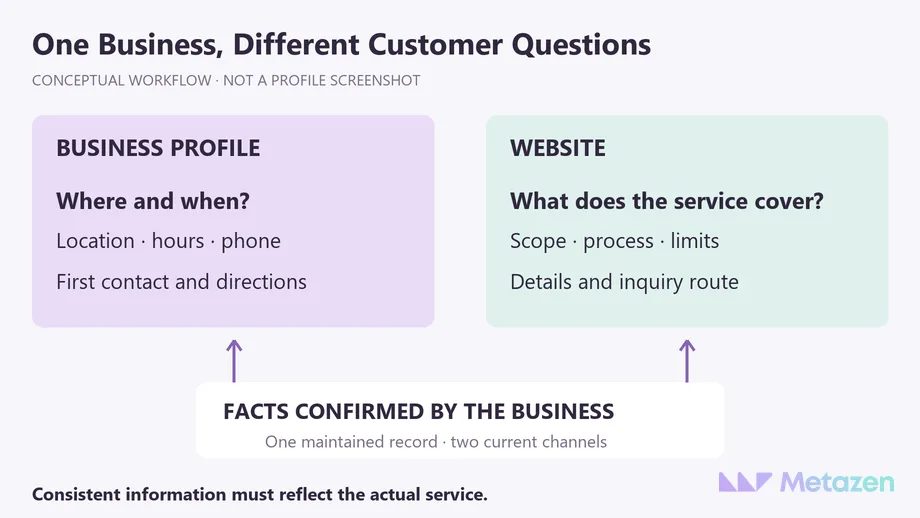
Read the page linked from the profile as a prospective customer. Can someone move from the service explanation to an inquiry or appointment request? Who receives the form submission? A page that says “contact us for a repair” but only offers a shopping cart leaves the visitor without a useful next step.
Explain location and service conditions where they help the customer decide, rather than repeating neighborhood names throughout the page. Google’s SEO Starter Guide emphasizes useful, understandable content. If the website is inaccessible or a service page cannot appear in search, apply the priorities for a technical SEO audit first. A profile rewrite cannot repair a website access problem.
4. Assign Responsibility for Review Requests and Replies
Review management involves more than watching a rating. Decide who asks for feedback after service and who handles questions or complaints. At the repair shop, the person handing back a bike may send the review link, while a technician handles a question about the repair.
Google’s review guidance calls for genuine experiences and prohibits incentives. Keep replies focused on the issue without publishing private customer details. Where a discussion needs to continue, offer an appropriate contact channel.
Repeated questions about walk-in appointments may reveal a gap on the service page. Confirm the shop’s policy, then make the answer easy to find. Feedback can improve the information available to the next customer, rather than remaining a conversation visible only beneath a review.
5. Separate Visibility, Interactions and Inquiries
A useful report answers three different questions: Are people seeing the business? Are they taking a contact action? Do incoming inquiries match the services offered? A single ranking screenshot cannot answer all three. Record the search term, observation location and date before comparing visibility snapshots.
In Google Business Profile reporting, calls count clicks on the call button, not completed conversations. Website clicks are not inquiry totals. Google says performance data can include organic results and Google Ads. If advertising is running, do not attribute the combined total to SEO alone.
The workshop may receive more website visits while most callers ask for a service it does not offer. More contact activity would not settle whether the work is attracting suitable customers. Track the requested service and whether the business could help, without collecting unnecessary personal details. Use the report to identify where expectations need correcting.
| Observed Problem | Owner and Deliverable | Completion Check |
|---|---|---|
| Profile and website hours disagree | The business confirms hours; profile and website owners update their channels. | Both customer-facing displays show the current hours. |
| The repair page omits pickup conditions | The business supplies conditions; the content owner adds them to the page. | The service area, request route and applicable limits are clear. |
| Form inquiries go unanswered | The web team checks delivery; the business assigns a recipient and follow-up owner. | A test inquiry reaches the correct recipient, with someone assigned to respond. |
| Reporting stops at visibility | The reporting owner presents interactions separately from the business’s inquiry records. | Metric definitions and outcomes that remain unverified are stated. |
When hiring outside support, put deliverables, required business input and implementation responsibilities in the proposal. Reporting on problems and making the changes are different scopes of work. Our criteria for assessing an SEO quote help you compare what a fee actually includes.
Build a Local SEO Plan Your Team Can Put to Work
Improving a profile and a website separately can leave gaps in the customer’s path between them. At Metazen, we favor starting with the obstacle that prevents someone from understanding a service or reaching the business. Our SEO, content and development team can review the current setup and help agree on business responsibilities and technical deliverables. Explore our SEO service to see how that work can fit your needs.

