

The first logo concepts arrive, and your only feedback is “Make it more modern.” Modern for whom? Seen where? Unless the business need was clear at the start, the next round may leave you just as unsure. A short logo design brief gives the designer a useful starting point and gives you a basis for judging the work.
A brief is a written explanation of the assignment: its purpose, boundaries and expected result. You do not need a polished presentation. Clear answers, relevant references and an honest list of open questions can be enough to begin the conversation. A logo is one part of a larger visual system; our explanation of brand identity and its relationship to a logo covers that wider scope. For a single logo commission, start with six questions.
1. What Does Your Business Do, and Why Do You Need a Logo?
A sector label gives the designer very little to work with. Explain what you offer, whose problem you solve and why the project is happening now. A new business trying to become recognizable has a different starting point from an established company entering another product category.
Imagine a neighborhood bicycle repair shop preparing to open. “We are in cycling” tells us less than “We maintain and repair bikes for people who ride to work; we do not want to look like a racing equipment store.” The designer does not have to draw every service into the mark. They do need to understand which impression would send the wrong message.
Write the business name exactly as it should appear. Will customers see the full registered name or a shorter trading name? Is the tagline settled? Mark undecided items clearly. A possible name change is something to discuss before lettering and layout work begins.
2. Who Will See the Logo, and Where Will They Meet Your Brand?
“Everyone” rarely helps narrow a design direction. Describe the customers you expect to serve first: what they need, where they find you and what affects their choice. A commuter trying to get a bike repaired before Monday is approaching the shop differently from a rider upgrading a competition bike.
Share useful evidence if you have it: customer conversations, recurring questions or observations from the sales team. If you have not started trading, label your audience description as a working assumption. The designer should be able to separate what you know from what you still need to learn.
The buyer and the user may be different people. A parent may choose a child's product; a procurement team may select a tool used by other employees. Tell the designer whose judgment the logo and surrounding communication need to address.
3. What Impression Should the Logo Create or Avoid?
Reliable, innovative, high quality: many businesses could choose the same words. Explain what the intended impression means in your setting. You do not have to dictate a shape or draw the answer for the designer. Describe what the design needs to achieve.
| Initial Request | More Useful Context |
|---|---|
| Make it modern. | We serve everyday bike commuters and want to avoid the aggressive look of a racing team badge. |
| Make it look premium. | We want to suggest careful workmanship; ornate decoration and a long tagline are not priorities. |
| It needs to work everywhere. | The first uses are our sign, social profile and service labels. It needs to remain recognizable in a small space. |
Send logo references with a sentence explaining each choice. You might like the readable lettering in one and the restrained symbol in another. Without that explanation, the designer has to guess what caught your eye. Adobe's guidance on working with a logo designer makes the same practical point about explaining your references.
Competitor examples can help define the context. Explain where you want to differ, rather than asking for a slightly altered copy of another mark. Treat color in the same way: an existing product range or a particular setting is more useful context than a universal claim that one color always creates trust.
4. Where Will the Logo Be Used, and at What Size?
List the applications you actually need first: signage, a website, a social profile, packaging, workwear or a service label. Rank them instead of adding every possible future product. A small circular profile image and a wide shop sign place different demands on the design.
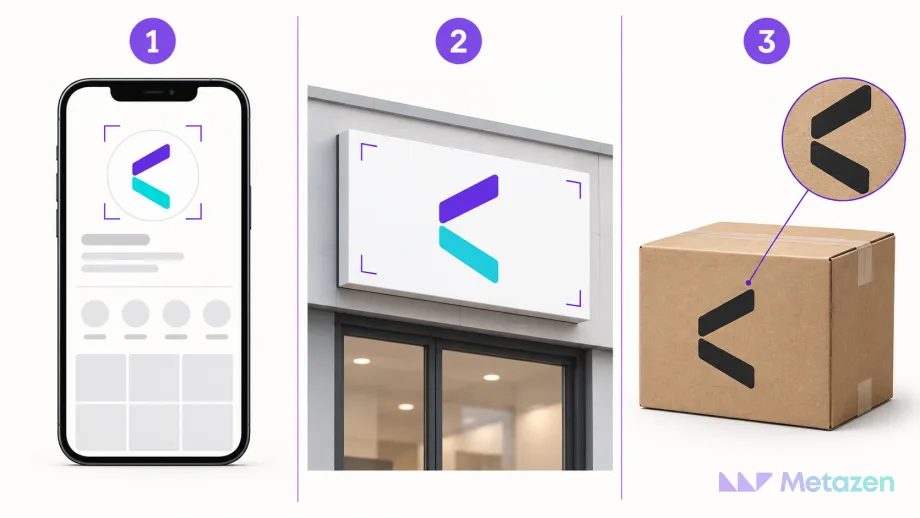
The three examples above call for different information in the brief. A profile may crop the mark. A sign has a particular layout and background. A box has printing constraints set by the supplier. Share photographs, dimensions and production contacts where available. Leaving every application until later can mean discovering a practical limitation after the design has been approved.
Adobe's logo design guidance discusses evaluating a mark at different sizes and in the versions it will need. Avoid prescribing a universal minimum size or line thickness; the application and production method affect what works. For printed materials, our print project preparation guide explains the information and proofing decisions to address with a supplier.
5. What Is Fixed, and What Is Open for Exploration?
Share any existing assets or constraints at the outset: a name that must remain, an established color, packaging already in use or a relationship with a parent brand. Separate a business requirement from a personal preference. “I like turquoise” and “It needs to sit alongside our existing turquoise product range” give different reasons for the same request.
Budget and timing belong in the discussion too. An opening date alone does not tell the designer when you can review concepts or provide approval. If signs or packaging must be produced, allow for the distinction between a design handover and finished physical items. The Design Council's guide for design buyers includes deliverables, budget and responsibilities alongside the project objectives.
Separate logo development from application design. A mockup showing the logo on a box does not mean production-ready packaging artwork is included. Agree which applications are evaluation examples and which are finished deliverables.
You do not need to arrive knowing every file format. Explain who will use the logo and for what, then agree on the required handover with the designer. If you already have license records for fonts or other assets, include them. A file with an unknown source should not be presented as an asset that is ready for unrestricted use. Once the design is approved, use the five logo handover checks to confirm that the agreed files are ready for their intended uses.
6. Who Approves the Work, and How Will Feedback Be Managed?
Identify the decision maker and the day-to-day contact before work starts. If the owner will only attend the final presentation, find out their non-negotiable requirements earlier. Uncoordinated comments leave the designer trying to work out whose instruction takes priority.
Connect feedback to a need in the brief. “The business name is hard to read on the small service label” identifies a problem more clearly than “Make the logo bigger.” Mention what is working as well. A revision can lose a useful feature if nobody explains why it should remain.
Discuss how many initial directions will be explored, how the chosen direction will be developed and what counts as an extra request. There is no revision count that suits every project. AIGA's guidance on defining a design proposal emphasizes making the review and approval process explicit.
A Short Example to Take to the First Meeting
Here is a starting note for the hypothetical bike shop, rather than a record of client work:
We maintain and repair bikes for local commuters. We want to feel approachable and careful, without looking like a racing team. The logo will first appear on our sign, social profile and service labels. The business name is settled; we are open to ideas for the symbol and colors. The owner will approve the work, and one person will collect feedback. We will agree on the budget, delivery date, initial directions and revision scope at the first meeting.
After sharing your note, ask the designer to explain the assignment back to you. Resolve different interpretations before the first concepts arrive. A useful brief does not require you to answer every design question yourself. It gives both sides a clear view of the decisions made and the questions still open.
Turn Your Logo Idea into a Brief a Designer Can Use
At Metazen, we begin by discussing where the design will appear, who it needs to reach and what it should communicate. You do not need to bring a finished sketch; your business context, intended applications and references give us somewhere useful to start. Meet our design and branding team and explore our graphic design service to see how a logo project can fit your wider needs. Bring the decisions you have made alongside the questions you want help resolving.

