

Two agencies can quote the same monthly amount for Google Ads and offer very different things. One adds its fee to your advertising budget. Another includes media, management and setup within a single total. Before deciding which proposal is better value, find out where the money goes.
Five questions make the comparison easier: How much reaches the ad account? What work does management cover? What needs to happen before launch? Which period and spending limits apply? And how will you see what the spending produced? You do not need to know every setting in the advertising interface to ask for clear answers.
Why Google Ads Does Not Have One Universal Price
Ad spend is the money allocated to advertising on Google. A management fee pays the person or team planning, monitoring and improving the campaigns. Tracking setup, creative production and landing page work may need their own scope.
In Search advertising, cost per click describes the advertising cost of a click. Google’s CPC documentation distinguishes a paid click from an impression. There is no fixed click price that applies to every advertiser. Auction competition, search context, and ad and landing page quality affect the outcome.
A budget alone cannot tell you how many customers it will bring. The demand you target and the offer you make matter too. If the services and search themes are still undecided, work through campaign planning around search intent before treating a cost estimate as a firm plan.
1. How Much of the Quote Actually Funds Advertising?
A line labeled “monthly advertising package” leaves too much unanswered. Ask for separate amounts for Google advertising, ongoing services and initial work. Google’s transparency requirements call for the Google advertising cost to be disclosed separately from service fees, with management charges explained in advance.
| Cost | What It Pays For | What to Clarify |
|---|---|---|
| Google ad spend | Advertising delivery | Allocation, dates, payment arrangements and access to spending records |
| Campaign management | The agreed monitoring and improvement work | Fee model, campaigns covered and deliverables |
| Setup and measurement | Initial preparation, required connections and verification | Necessary tasks, responsibility and any one-time charge |
| Copy, creative or page production | Materials needed for the campaign | Included deliverables, quantities and additional-work terms |
The last two rows do not mean every project needs new work. Reliable existing tracking and usable ad materials may be retained. If a proposal lists a setup charge, ask which gap it addresses.
Clarify whether taxes and any other charges are included in the quoted total. Use your account’s billing arrangements and the written proposal rather than assuming a tax treatment from an online example.
2. What Work Does the Management Fee Cover?
A lower fee is hard to evaluate without a scope. Launching a campaign is different from reviewing search terms, excluding irrelevant searches, developing ads and discussing results throughout the month.
Put the work next to the price. Expand “ongoing optimization” into the data that will be reviewed, who makes decisions, how feedback is handled and what reporting you receive. If daily monitoring is promised, ask what is monitored. It should not imply that settings must change every day.
- Flat fee: Which accounts, campaigns and tasks are included? What happens when the scope grows?
- Percentage of spend: Is the percentage applied to the planned budget or actual media spend? Is there a minimum fee?
- Flat fee plus a percentage: Can the provider show the total calculation in one worked example?
The pricing model alone does not tell you whether a service is worthwhile. You need to understand how responsibilities change when the fee changes. Agree who can approve a budget increase before anyone makes one.
3. What Needs to Be Ready in the First Month?
Ads may already be running in the account you want someone to take over. Before relying on its reports, check what the conversion actions actually count. A click on a submit button and a successfully accepted form are different events; confusing them can distort the report before anyone evaluates the campaign. Ask whether the initial scope includes that check.
“Install tracking” needs a clearer definition. Which customer action will be measured, who will test it, and what record will confirm the result? A conversion tracking plan from form submission to sale helps describe the measurement work you need.
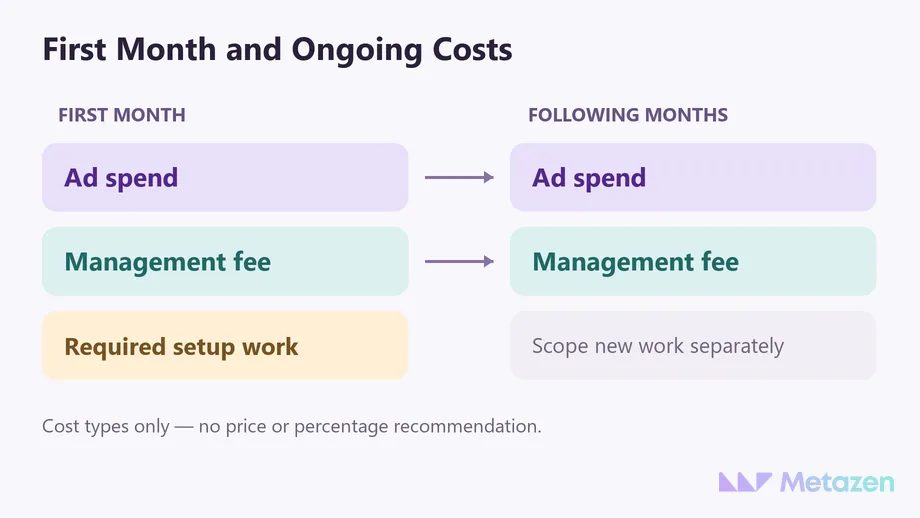
Request one total for the first month and another for the ongoing arrangement. Ad spend and management may continue each month, while agreed one-time preparation should not quietly reappear as a recurring charge. Continuing technical support or new production should have its own stated scope.
A useful question for the call: “Which parts of the existing account and website can we keep? Could you list what needs rebuilding, why it is needed and how we will confirm it is complete?”
4. Which Dates and Spending Limits Does the Budget Cover?
An average daily budget is not an exact amount spent every day. Under Google’s spending-limit rules, most campaigns using an average daily budget have a daily billing limit of twice that budget and a monthly limit of 30.4 times the budget.
Calculation example only: An unchanged $20 average daily budget over a full calendar month gives most campaigns a $40 daily limit and a $608 monthly limit. It does not mean Google will spend $40 every day or necessarily use the entire $608. The figures are not a recommended starting budget; agency fees and applicable taxes or other charges are excluded.
Starting mid-month or changing the budget affects the calculation. Running ads only on selected days does not, by itself, turn the monthly limit into “scheduled days multiplied by daily budget.” Check the proposal’s date range and campaign budget type together.
Check the budget type. A campaign total budget limits spending across its date range; the daily-budget formula does not apply. Special arrangements such as paying for conversions have different daily-limit rules too.
For the interface steps, see the Google Ads setup walkthrough with screenshots. During a proposal discussion, focus on what the chosen amount funds, for which campaigns, and over which dates.
5. Which Records Will Show What the Spending Produced?
“Monthly reporting included” says little about the decisions a report will support. How much went to Google? Which action counted as a conversion? Which inquiries were suitable for the business? Compare figures from the same date range. Do not expect the media cost in Google Ads to equal an agency invoice that includes professional services. Once the report arrives, use five client review checks to establish what the evidence supports and who owns the next action.
Discuss payment arrangements, account access and the eventual handover before work starts. Know your own advertising account’s identity rather than accepting an unclear arrangement shared with unrelated businesses. Google’s third-party policy requires a separate account for each advertiser.
A request for more budget should come with a reason. Are more suitable inquiries available, which opportunities is the current budget limiting, or does the destination page need attention first? Higher spending alone is not progress. The outcome you want and the measurement being used need to match.
A Short Example of Comparing Like-for-Like Proposals
Consider two hypothetical proposals. Provider A separates media and management, includes a tracking check and excludes a new landing page. Provider B gives one total, leaves measurement unspecified and charges extra for page production. You cannot yet tell which offers better value. Provider B’s total needs breaking down first.
Send both providers the same brief: the service being advertised, target location, destination page, customer action to measure, current access and test period. Keyword Planner forecasts can inform the initial discussion, but an estimated click count is not a promise of sales.
You should leave the conversation able to see the media budget, management fee, first-month work, exclusions and approval responsibilities on one page. Resolve missing information before negotiating the price.
Let’s Define the Work Your Advertising Budget Needs
At Metazen, we consider advertising alongside the business’s goals, website and measurement needs. When a project involves both campaign management and technical preparation, our digital marketing and development team can look at the same problem from both sides. Explore our paid advertising management service to discuss the work needed around your media budget.

