

Poor ad lead quality often becomes visible when form submissions and sales conversations tell different stories. Inquiries may be rising while your team handles requests for services you do not offer, struggles to reach people or has no record of why quotes were declined. Before changing campaigns, separate a poor fit from a lead nobody has assessed yet.
A qualified lead meets your business's service and customer criteria and is worth a sales conversation. Qualification does not mean a purchase has happened. Google Ads distinguishes qualified leads from leads that complete a later conversion step. If you need to define how submissions, qualified opportunities and sales will be measured, start with an advertising conversion tracking plan. To assess fit, record why an inquiry was ruled out alongside the count.
1. Separate Poor Fits from Unresolved Leads
“The leads are bad” does not tell anyone what to fix. Review recent inquiries for the same service and allow comparable time for assessment. Record what the form or conversation actually revealed, rather than a general impression.
| What You See | What It Does Not Yet Prove | First Check |
|---|---|---|
| A service you do not offer is requested | The entire campaign is wrong | Search intent, ad copy and service description |
| Invalid or duplicate submission | Real prospects are uninterested | Form validation and duplicate records |
| No contact has been made | The inquiry is a poor fit | Ownership, first response and contact history |
| The need fits, but the timing does not | The ad reached the wrong person | Expected start date and follow-up decision |
| A conversation took place, but the quote was declined | The lead had no value from the start | Scope, expectations and the recorded reason for losing the opportunity |
Consider a business that installs new equipment but does not repair existing units. A repair request and an installation inquiry that received a late response are different problems. The first points toward the offer or traffic; the second needs a look at lead handling. A single “unsuccessful” label hides the distinction.
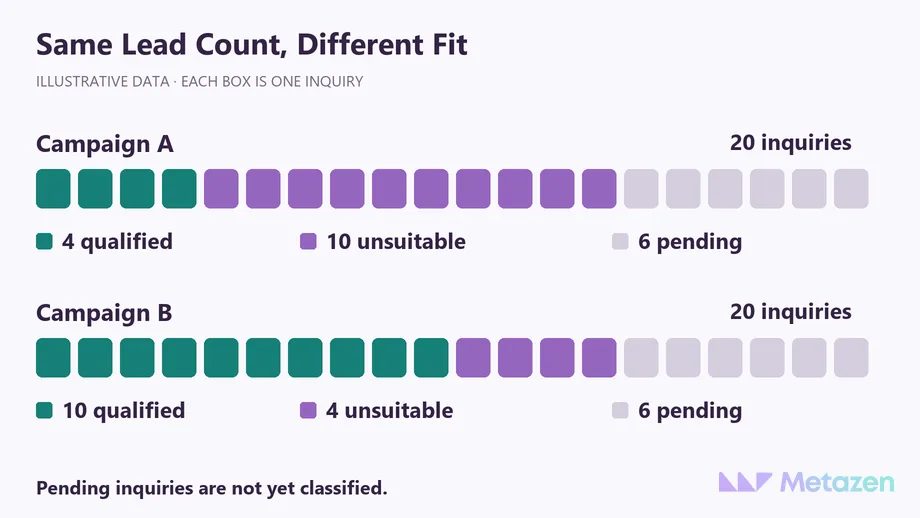
A pending lead is not an unqualified lead. Keep contact attempts, conversations and decisions separate. HubSpot's lifecycle and lead status definitions distinguish attempted contact, bad timing and disqualification. You can maintain those distinctions without using that software.
2. Check the Intent Behind the Traffic
In search advertising, the keyword you selected is not necessarily the phrase someone typed. Use the search terms report to distinguish buying a service from looking for instructions, a job or another product. The report does not show every query, so leave room for what you cannot see.
For the installation business, “how to install” and “installation quote” suggest different expectations. Still, avoid making decisions from an isolated word. Someone asking about price may be close to buying, while “free” could refer to a site assessment you actually offer. Read the whole query and check your service scope before excluding traffic with negative keywords.
On social platforms, review how the channel fits the audience and message rather than expecting an equivalent search query. If requests outside your service area or scope cluster around a particular source, examine who saw the ad, where it appeared and what it offered. Cheap clicks alone do not show that expansion is bringing suitable work to the sales team.
If the structure of your search groups needs attention, revisit the campaign plan connecting intent, ads and landing pages. To see where location, keyword and ad choices appear in the account, follow the screenshots in our Google Ads campaign setup walkthrough. An unsuitable inquiry does not automatically call for rebuilding the account.
3. Compare the Ad's Promise with the Actual Offer
Put the ad, landing page and sales explanation side by side. An ad offering an instant quote creates a different expectation from a page with general information and a sales team that needs a technical assessment before pricing the work.
Make the details a prospect needs before submitting clear: what you provide, who it suits, what falls outside the scope and what happens next. If pricing depends on the project, explain the information needed for a quote without implying a fixed amount. Google's ad and landing page guidance connects an accurate offer with what people find after the click. Review how the offer, evidence and inquiry route fit into the page when deciding where missing explanations belong.
“Find better customers” is not a change someone can implement. For a business that only installs new systems, stating that repairs are outside its scope gives the team a specific change to test. Review whether the same mistaken requests continue afterward; changing the wording is not proof that the problem has been solved.
Google Ads Quality Score does not measure lead quality. Quality Score is a diagnostic indicator covering expected click-through rate, ad relevance and landing page experience. Customer fit comes from inquiry and sales records.
4. Find the Information Your Form Is Missing
If every sales conversation opens with the same basic question, consider whether the form needs that information. Service type, project location or a short description of the need may help. Decide how the answer will be used before adding a field; do not make a question mandatory if it changes no decision.
A longer form is not a lead quality strategy on its own. The W3C forms tutorial recommends asking for information needed for the process and keeping questions clear. Each extra field can make submission harder. Check whether suitable prospects can complete the form and whether their answers help your team assess the request.
Invalid contact details and a real person asking for the wrong service need different responses. The first calls for validation and record checks; the second calls for clearer expectations and a review of intent. After submission, people should understand that their request was received and what the team will do next.
5. Connect Sales Feedback to Campaign Decisions
Give the person managing ads more than “no sales.” Share a record ID and a short reason: which service was requested, when contact was first attempted, whether a conversation took place and why the lead was ruled out, if applicable. A shared working table needs the information that supports the decision, not unnecessary personal details.
Compare the same stage after a similar amount of follow-up time, checking the report’s period, cost scope and outcome definitions together. Yesterday's inquiry has not had the same chance to progress as one your team has worked for two weeks. Look at qualified, unsuitable and pending records alongside the total. To calculate ad cost per qualified lead, divide spend attributable to a defined group by qualified leads from that same group. Do not label it cost per sale. When comparing costs, separate Google ad spend from management and setup fees; a figure based only on media spend is not directly comparable with one that includes the full service cost.
If the campaign uses automated bidding, review the outcome it is optimizing toward with your measurement team. The role of primary and secondary conversions depends on the goals in use. Renaming a form submission “qualified lead” is not the same as feeding back the leads your sales team has actually qualified.
- Record the main problem and its evidence, such as repeated requests for a service you do not provide.
- Choose a limited change aimed at that problem, with an owner and a date.
- Review the inquiries generated afterward using comparable assessment periods.
Changing every setting at once makes it harder to understand which decision helped. Once the problem is visible, the work needed from advertising, the website and sales becomes easier to assign.
Let's Find Where Suitable Opportunities Are Being Lost
At Metazen, we assess advertising decisions against the needs a business can actually serve, as well as the submissions in the platform. Our digital marketing and technical team can bring traffic sources, offer clarity and sales feedback into the same plan. Explore our advertising management service to see how we can help identify the weak point and define the next practical step.

