
Two software quotes both list customer records, an order screen and reports. Their prices are far apart. To understand why, look behind the screen names: who can change an order, what happens when the accounting connection fails, and who will clean up the old records? Custom software costs depend on how the application must behave, not just what appears on screen.
Imagine an order management application for a warehouse. One proposal may cover adding and listing records. Another may include permissions for each branch, accounting synchronization and migration of historical data. Calling both projects an order system does not make their scope equivalent. Five areas of uncertainty can help you locate the difference before comparing totals.
If you are still deciding between commissioning an application and using an existing product, first consider when custom software is a suitable choice. If you need a site to present your services rather than an operational application, the website quote comparison criteria are a better starting point.
1. How Clear Are the Business Rules and Permissions?
“Edit an order” can look like a small feature. Can a sales representative change only their own orders? Can an order be edited after it reaches the warehouse? Does an invoiced order need a cancellation or correction process? Each answer determines behavior that the development team must implement.
A quote that promises three user roles still leaves questions open. Roles may differ in access to individual records, approval rights and what happens after a person moves to another role. OWASP’s authorization guidance covers defining and testing permissions for users, resources and actions during development.
Ask which business rules the supplier has included. Instead of accepting “standard permissions,” compare the proposed behavior for the sales representative, warehouse supervisor and manager. Paying for an unnecessary approval layer makes little sense; leaving out a required control can be just as costly a mistake.
2. What Does Each Integration Actually Do?
An API is an interface through which applications exchange data under defined rules. An accounting platform offering an API does not establish that every record or action you need is available. Check the relevant version, access permissions, supported operations and test environment before treating the connection as confirmed scope.
Sending an approved order to accounting is different from receiving payment and cancellation updates and keeping both systems aligned. The second arrangement raises questions about which record is authoritative, how failed transfers are reported and what happens when changes conflict.
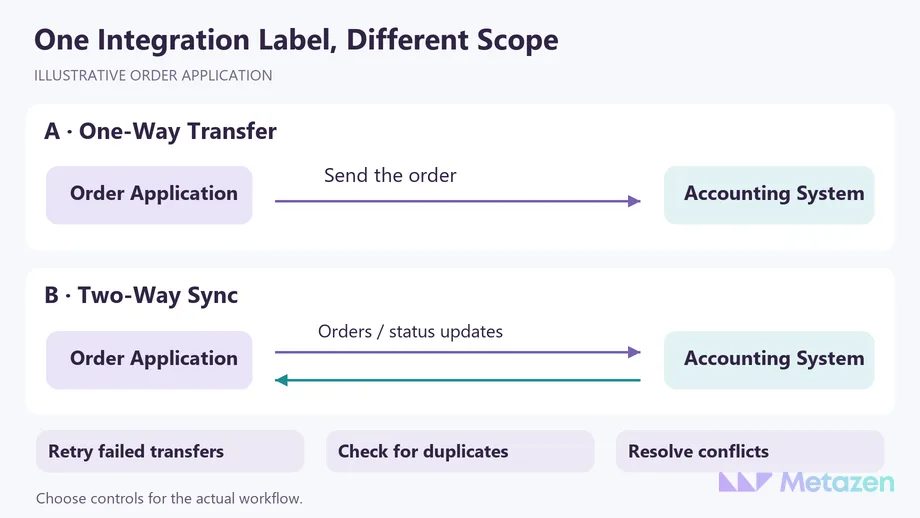
Retry behavior deserves particular attention when an action has consequences, such as collecting a payment. Stripe’s documentation on idempotent requests illustrates a way to retry after a connection failure without creating the same operation twice. Other services may behave differently, so the team needs to verify the available controls.
Replace “Is integration included?” with a more useful question: which records move in which direction, how often, and who learns about a failure? Use an integration plan covering data flow and ownership to make the answer part of the agreed scope.
3. Is the Existing Data Ready to Move?
A customer list in a spreadsheet is not a fully defined migration task. The same customer may appear under several names, product codes may have changed and required fields may be empty. Looking at a sample tells the team more than a record count alone. If the move has not been agreed, first assess whether the spreadsheet problem justifies an application before treating data migration as a requirement.
IBM’s explanation of data migration includes data quality and validation alongside the source and target structures. For a buyer comparing quotes, the practical question is who will prepare the old information for the new application.
- Which records need cleaning or conversion, and which can remain in an archive?
- Who will approve the mapping of customer and product codes to new fields?
- Which sample transactions will establish that the trial migration worked?
- How will records added to the old system during the final transition be handled?
One supplier may price only the import of a clean file. Another may include examining the file and resolving problematic records. A line saying “data migration included” does not reveal the difference. Remove personal and commercially sensitive information from initial samples; agree the conditions for access to real data separately.
4. Under What Conditions Must the Application Work?
A short demonstration with a small dataset may not represent a busy working day. Beyond opening the order list, delivery expectations can include what happens when people edit the same record, an external service stops responding or a user attempts an action outside their permissions.
Acceptance conditions describe the observable results needed to consider work complete. A warehouse manager might need to see their own branch’s open orders, be prevented from changing another branch’s records and notice a failed transfer. If you need performance or concurrent-use targets, define the dataset and operating conditions alongside them.
The quote should assign responsibility for the test environment, sample data, user acceptance work and rechecking corrected issues. Microsoft’s application lifecycle overview places development alongside testing, deployment and maintenance. Finishing the code does not automatically finish every delivery task.
5. Who Owns the Costs After Launch?
Read the development fee separately from the cost of keeping the application running. Hosting, licenses, external services, backups, monitoring and support may come from different providers or internal teams. An item missing from a quote is not necessarily an item your business can do without.
Microsoft’s cost-model guidance considers initial and continuing costs in relation to usage. Alongside the delivery fee, record recurring commitments and the work your own staff will take on.
Unpack “maintenance included.” Does it cover correcting defects within the accepted scope, adapting an integration when an external service changes, or developing new features? Agree support coverage, how an issue is reported and who is responsible for resolving it. Do not assume that a fixed percentage of the original development price suits every application.
If the project will become a subscription product for customers, plan beyond internal use. Customer accounts, service continuity and support create responsibilities of their own. The obligations involved in building a SaaS product belong alongside the revenue plan.
The Same Line Item Can Cover Different Work
The following example is not a real quotation. It shows why scope descriptions need to be unpacked for the same proposed order application. Column B is not automatically better or necessary; your operating needs determine which work is justified.
| Item | Quote A | Quote B |
|---|---|---|
| Accounting connection | One-way transfer of approved orders | Synchronization of order and payment statuses |
| Data migration | Import of a file cleaned by the business | Sample review, field mapping and assessment of problematic records |
| Delivery checks | Demonstration of agreed core operations | Core operations plus agreed load and failure conditions |
| After launch | The business takes over operations | Monitoring and support within written limits |
Do not immediately read a lower price as missing work or a higher price as superior quality. Resolve the scope differences first. Then compare the approach, delivery responsibilities and terms of teams proposing to do equivalent work.
Reduce Uncertainty Before Comparing the Totals
An estimate is useful only in relation to the information behind it. GAO’s cost-estimating guidance includes documenting scope, assumptions and uncertainty. A practical starting point for your business is to separate confirmed requirements from decisions that are still open.
Identify the complete workflow needed in the first release. Prepare a data sample, locate the documentation for external systems and ask suppliers to state any assumptions about unverified connections. If the workflow itself is still unclear, use the pre-quote requirements preparation steps to organize the inputs.
Do not treat an unverified integration as an established delivery commitment. Agree what an initial technical investigation covers and how its findings could change the proposal. Hiding an unknown does not resolve it.
Finish the comparison by asking: “Which changed assumption would make us revisit the price?” The answer can be as useful as the feature list. Agree who will approve the scope, schedule and fee impact of new requests before they enter development.
Build a Clearer Scope with Our Software Team
At Metazen, we approach software through the work people need to complete, the data connections involved and the ability to maintain the application over time. Explore our team’s software expertise and share the process you want to improve or the scope you need priced. Our custom software service explains how we take requirements into application development.

