
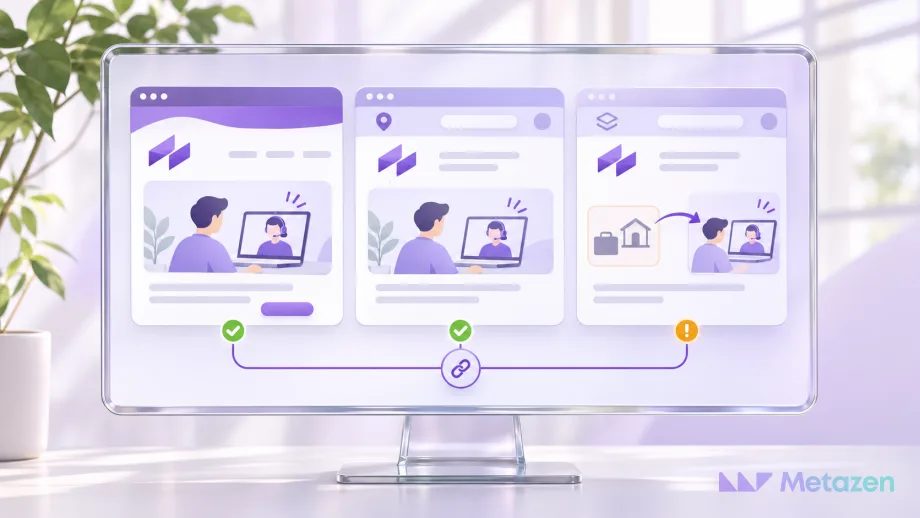
Your website says setup is provided remotely, but an industry directory still promises an on-site visit. Which version should a prospective customer believe? Resolving conflicting company and service information starts with confirming the actual terms, then correcting each affected source. Updating the About page alone may leave the wrong promise in circulation.
Business information consistency means that facts about the same organization do not contradict one another across sources. It does not require identical wording everywhere. A short profile and a detailed service page can serve different purposes while agreeing on who provides the service, what is included and which conditions apply.
Being more visible under the wrong service description creates an expectation problem. For the wider context, read what GEO and AEO aim to do. The practical task here is to give customers and systems reliable information about the business before making that description more persuasive.
1. Establish Which Facts Are Correct
Do not treat the most frequently repeated description as the authoritative version. An outdated company introduction may have been copied for years. Ask someone who knows the current arrangement: an operations lead can confirm the service scope, while an authorized business contact confirms the name and contact route. Mark unresolved information as awaiting confirmation instead of filling the gap with a guess.
A short internal record is enough. Put the fact, applicable conditions, person confirming it and review date together. “Setup is available” leaves room for interpretation. “Standard setup is remote; on-site setup is no longer offered” identifies the old promises that need attention. A customer-facing office might remain open for other work; changing one service does not necessarily change the entire business model.
A brand name and legal company name can legitimately differ. Check whether readers can understand the relationship. A founder’s professional experience and the company’s age are different facts too. Do not turn a person’s career history into an earlier company founding date. Google’s Organization documentation supports supplying names and other identifying details in structured data. Choosing a field comes after establishing the fact.
Start with errors that change a customer’s decision. A disconnected number, discontinued service or incorrect customer-facing address deserves attention before a punctuation difference. Repeating an error consistently across every source does not make it accurate.
2. Find the Sources That Disagree
Search separately for the company name, any former name and the service that changed. On your own website, review About, contact and service pages alongside relevant older articles. Elsewhere, check profiles you manage, industry directories and relevant coverage of the business. Select records where a customer could encounter the wrong conditions instead of collecting every mention.
The page title or search description might still promise an old service even after the body has been updated. Compare the visible copy with its title, description and any structured data. If you need to decide whether to retain, update or consolidate pages on your own site, use the approach in our GEO content audit. The cross-source check asks a narrower question: which URLs describe the same fact differently?
| Fact to Check | Observed Difference | First Action |
|---|---|---|
| Service Terms | The website says remote setup; a directory promises an on-site visit | Confirm the current terms and request a directory correction |
| Contact Details | An older profile shows a discontinued phone number | Verify the correct number and access to the profile |
| Company Name | One source uses the brand, another the legal entity | Check whether both clearly identify the same organization |
| Service Area | An old description includes an area no longer served | Confirm current coverage with the service owner |
The entries are hypothetical. In a working record, include the URL, exact passage, check date and person following up. A phone number written with different spacing is not equivalent to a different phone number. Check the meaning and where the customer will actually end up.
Our local SEO work plan covers the broader relationship between Maps profiles and website pages. The task here is factual consistency across existing sources, rather than setting up profiles or planning a local ranking campaign.
3. Use the Right Correction Route for Each Source
On Your Own Website
State the current service terms in visible copy and remove conflicting promises from affected titles, descriptions and other pages. Keep any condition that changes a buying decision when shortening the text. Our approach to writing answers with evidence and clear limits helps preserve the scope of a service statement.
Ask the technical team to review the structured data as well. Google’s structured data policies require it to reflect the visible content. Valid syntax does not prove that a service claim is true. The sameAs property is for references that unambiguously identify the same entity, rather than every article that happens to mention the company.
In a Business Profile You Manage
If you use Google Business Profile, edit the relevant field through an authorized account. Review the name, address, service area and description in their appropriate fields instead of loading the name with a service list. The profile guidelines require an accurate representation of the real business. An online-only company is not automatically eligible for a profile.
Knowing the correct information and having permission to edit the account are separate responsibilities. The business confirms the terms; an authorized person makes the change. Google’s owner and manager roles let people use their own accounts without sharing a password. Include the information record and outstanding corrections when handing work to a new agency.
In a Source Someone Else Publishes
Give the publisher the page URL, incorrect passage, proposed correction and a public source supporting it. A precise request is easier to assess than “please update our details.” Do not disclose customer records or confidential agreements as public evidence. Track acceptance and the eventual published wording separately; you do not control a third party’s copy.
For an error in a Google knowledge panel, use the panel feedback route. If the description comes from an identified source, address the error at that source first. Correcting the information does not guarantee that a panel will appear or display your preferred sentence.
4. Verify the Public Result and Follow Up on Open Work
Submitting an edit and seeing a correction are different stages. A Google profile edit can be pending, accepted or not approved. Keep the submission date separate from the observed result in your own record. A corrected website page is not evidence that an external listing has been corrected too.
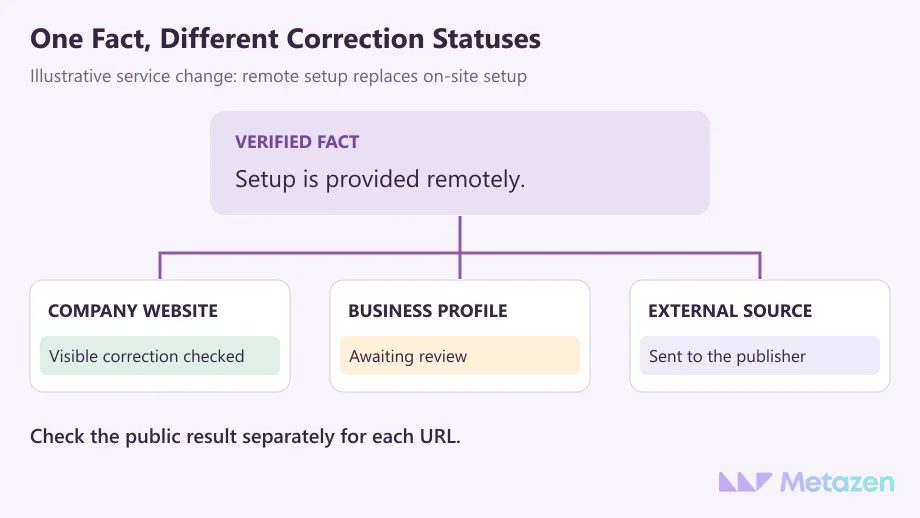
Open the public page after the correction and read the relevant field again. Does an old promise survive elsewhere on it? Does the profile show the right service coverage? Who will check the pending request next? Brief answers make a more useful handover than a single completed checkbox.
Reopen the source list when an address, phone number, service condition or team role changes. Google may update profile information from other sources, so keep an eye on profile notifications. The record should remain useful after the initial cleanup.
Correcting a source cannot make every AI product change its answer on the same day. Retain an incorrect answer as an observation, with its platform, date, prompt and cited URL. Do not promise a fixed delivery date for a response you cannot control.
Google’s AI features guidance builds on existing SEO practices, including current profile information and structured data that matches visible text. It does not require a special AI schema. Once the correction is published, use an AI visibility measurement record to observe subsequent answers separately. A new citation does not establish that the wording change alone caused it.
Let’s Make Your Company Information Easier to Trust
At Metazen, we assess a service description against what the business actually provides, as well as how clearly it reads. Our content and digital marketing team combines editorial experience with technical review. Explore our GEO and AEO service scope to see how we can help investigate conflicting sources and prioritize corrections. A useful starting point is a defined list of misleading records, with someone responsible for each follow-up.

