
Your service page promises weekend support, while the help section lists weekday availability only. Publishing another blog post will not resolve the conflicting information. Someone needs to establish the actual service terms and bring the customer-facing explanations into agreement.
A GEO content audit identifies what to retain and what needs to change across your existing pages. GEO refers to work on visibility in generative AI search; our introduction to GEO and AEO explains the wider scope. The editorial task is to turn vague improvement suggestions into work tied to a specific URL, a reason and an accountable owner.
Match Customer Questions to Existing Pages First
Start with the questions that matter to your business, rather than a commitment to rewrite every page. Look at recurring sales questions, service conditions and explanations that create problems when misunderstood. “Which locations do you cover?”, “Is setup included?” and “Can the product connect to our existing system?” may belong on different pages.
Record the URL that should answer each question. Include service and product pages, help content, business and team information, and relevant articles. Restricting the audit to the blog could leave an outdated condition on a sales page untouched. If no existing page seems to fit, use search intent to decide where the answer belongs: does the question deserve a separate page, or would a missing explanation complete an existing one?
A defined service area can make the first review manageable. For a maintenance business, the initial group might include its service page, opening hours and support terms. Record which areas have not been reviewed. Examining a small selection does not establish that the entire website has passed an audit.
Connect Every Finding to Evidence
A URL list is a starting point, not a finished audit. GOV.UK’s guidance on managing existing content brings inventory, regular review and changes based on observed problems together. For your review, record the following fields:
- Page and purpose: Full URL, language, page type and the customer question it should answer.
- Observed gap: The relevant heading or passage, what is missing and the expectation a reader could form.
- Verification evidence: Current service terms, product documentation, a source that can be checked or the person responsible for confirming the information.
- Decision: Retain, update, assess for consolidation or review for retirement.
- Work record: Owner, outstanding information, priority rationale and acceptance criteria.
Replace “weak content” with the unanswered question. Even “integration details are missing” may be too vague. Is the supported system unnamed? Is the direction of data transfer unclear? Does the reader need to know whether the integration is included in the price? The person making the edit should not have to reconstruct the finding before work can begin.
Missing evidence is not a confirmed defect. Mark a page as “not reviewed” if nobody has inspected it, or “awaiting confirmation” if the service terms are unknown. The absence of a citation in one tool does not establish that the page is inaccurate or inaccessible.
Review Answers, Evidence and Business Details Separately
First, look for the answer the page promises. A heading about setup scope followed only by general product benefits leaves the reader without the information needed to decide. Explain who must prepare what and which tasks are excluded. If the problem lies in the wording of the answer, our approach to preparing answers with clear evidence and limitations can guide the edit.
Next, examine the claims. “Works with every system” is not an accurate description of a service with two verified integrations. The useful revision names the supported scope rather than making the promise sound more impressive. Google’s content evaluation questions emphasize accuracy, original value and whether the explanation meets the reader’s needs.
Compare business details in a separate pass. Do service names, support terms, contact details or team roles conflict across pages? A trading name can legitimately differ from a registered company name; the relationship should be understandable. Google’s Organization documentation explains how organizational details can help distinguish a business. Establish the correct visible information before adding it to markup.
Structured data expresses page information in a defined format for software. Google’s structured data guidelines require it to represent the visible content. Passing a syntax check does not establish that the support hours are accurate. The same error can appear in both the text and the code.
An editorial review does not complete the technical access checks. Eligibility as a supporting link in Google AI Overviews or AI Mode requires indexing and eligibility for a search snippet. Google’s AI features documentation does not require a special AI schema. Suspected access or indexing problems belong in a separate AI crawler access investigation. Do not assume that Google’s requirements describe every AI product.
Give Each Page an Appropriate Decision
The value of an audit is not the number of pages rewritten. Retaining accurate, useful content is a valid outcome. The hypothetical examples below show why different findings need different decisions. They are neither client results nor automatic rules.
| Observed Situation | Possible Decision | Check Before Acting |
|---|---|---|
| An older explanation remains accurate and sufficient | Retain | Are the service terms and supporting source still valid? |
| The service page omits part of the support scope | Update | Who can confirm the actual terms? |
| Two articles give the same answer to the same question | Assess for consolidation | Does either serve a distinct need or contain useful original detail? |
| A discontinued service is presented as currently available | Review for retirement | Do existing customers need an archive notice, retained information or a suitable redirect? |
Sharing a keyword does not make two pages redundant. “How do I install it?” and “What does the installation quote include?” can serve different purposes. Compare the question, answer and distinct value before deciding to combine pages.
Removing a URL or relocating its content requires a plan for links and redirects. Google’s canonicalization documentation distinguishes the available technical methods. Sending every retired page to the homepage or adding noindex to anything that looks similar is not an automatic consequence of an editorial decision.
Prioritize the Consequences of Incorrect Expectations
An inaccurate service condition can directly affect a buying decision. Finding it on a less-visited help page does not make the error harmless. Review verified inaccuracies and gaps that prevent a decision first, then work that would strengthen an otherwise useful answer. Cosmetic preferences need not carry the same urgency.
Write a short reason beside the priority: “Applicants could expect weekend support; the operations owner has confirmed the actual terms.” When a finding is unverified, the first task may be to obtain the missing information rather than change the copy. If a score or supplier report triggered the review, open the affected URL and check the evidence behind the GEO report before accepting its conclusion.
Turn a Finding into an Edit You Can Accept
Consider a hypothetical maintenance business whose service page says “support every day.” The operations owner confirms that standard support runs on weekdays, with weekends covered only by a separate agreement. “Improve the GEO content” no longer describes the work precisely enough.
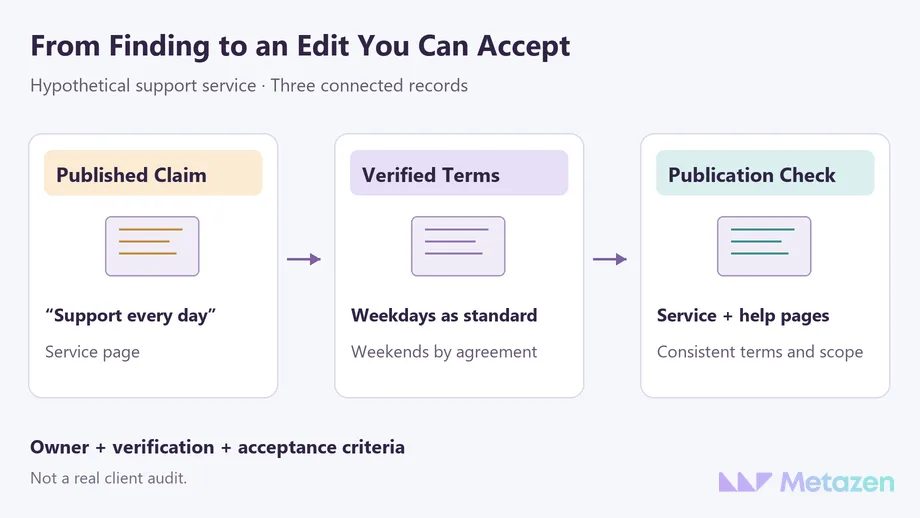
Acceptance criteria: The service explanation and help answer will describe the same standard support days and weekend exception. The content owner will revise the wording, and the operations owner will confirm the terms. Publication checks will cover both URLs, their summaries and their FAQs. If related structured fields change, the developer will update them to match.
Keep the previous wording and dates of substantive changes in the private work record. A visible update date should reflect a genuine edit. Google’s guidance on page dates recommends consistency between visible and structured values. Do not change a date merely to make a page appear newer.
Confirming that accurate content is published and observing subsequent AI answers are separate checks. Use the record-keeping approach in our AI visibility measurement plan to track the latter. A citation appearing or disappearing in one response does not, by itself, explain the effect of the edit.
Build a Content Update Plan with Our Team
If you have a page list but no clear order of work, Metazen’s content and technical team can map customer questions to existing explanations and define the revisions needed. We approach the deliverable as a work list with clear acceptance criteria. Explore our GEO and AEO service scope to see how we plan content review, technical checks and visibility monitoring together.

