

The monthly report arrives with more brand mentions and several green charts. Yet you leave the meeting unable to say which problem was solved or what should happen next. You need to see the observations behind the numbers and the decisions they support.
A GEO report should distinguish the work completed from the outcomes observed in AI answers. If the terminology is new, start with what GEO and AEO mean. The five checks below help a client assess a delivered report. If you have not established a monitoring process yet, our AI visibility measurement guide covers that earlier step.
1. Are the Scope and Calculation Explained?
Before accepting a headline score, find out which tool, report, platforms and dates it represents. Does the prompt set contain only questions that name your brand, or does it include questions someone might ask before knowing you exist? Results for English-speaking users in the US should not quietly become evidence of visibility in another market.
Separate a supplier’s own monitored prompt set from findings drawn from a tool’s wider database. For the former, ask for the prompt list and repeat conditions. For the latter, request the database coverage, filters and refresh information. Either can be useful, but they do not necessarily observe the same things.
Even Semrush’s metric definitions distinguish visibility measures across modules. Naming the tool is not enough. A cell labeled “Visibility: 60” needs a report name and a definition; it should not be read as reaching 60 percent of AI users.
Do not use a score to approve performance until its source, scope and calculation are clear. Ask for the missing explanation first. An evidence gap does not automatically establish poor results or poor service.
2. Can You Inspect the Answer Behind the Claim?
Open the answer used to support “Our brand is being recommended.” Is the business listed as an option, mentioned as a negative example or confused with a different company? If there is a citation, inspect the exact URL and check whether the page supports the relevant statement.
Suppose an answer describes your maintenance service as available on weekends, and the report presents that answer as a success. If the service runs on weekdays only, the misleading expectation needs attention before the team seeks more exposure. Review the saved answer, cited page and current service terms together before commissioning more content in the same direction.
Semrush’s full-response view is one example of a tool that lets reviewers inspect the prompt, sources and update details. Ask your supplier for a comparable path from a claim to its evidence. Screenshots can serve that purpose if they retain the date and context; account details and private customer information can be concealed.
Meanwhile, the citation count described in Bing’s AI Performance announcement does not express placement within an answer. A total from that report is not evidence that your brand was the first recommendation everywhere.
3. Are the Reporting Periods Comparable?
“Mentions increased by 50 percent” may be arithmetically correct without establishing progress. Imagine an earlier period with mentions in 8 of 20 answers and a later period with mentions in 12 of 60. The count rose from 8 to 12, while the share of observed answers fell from 40 percent to 20 percent.
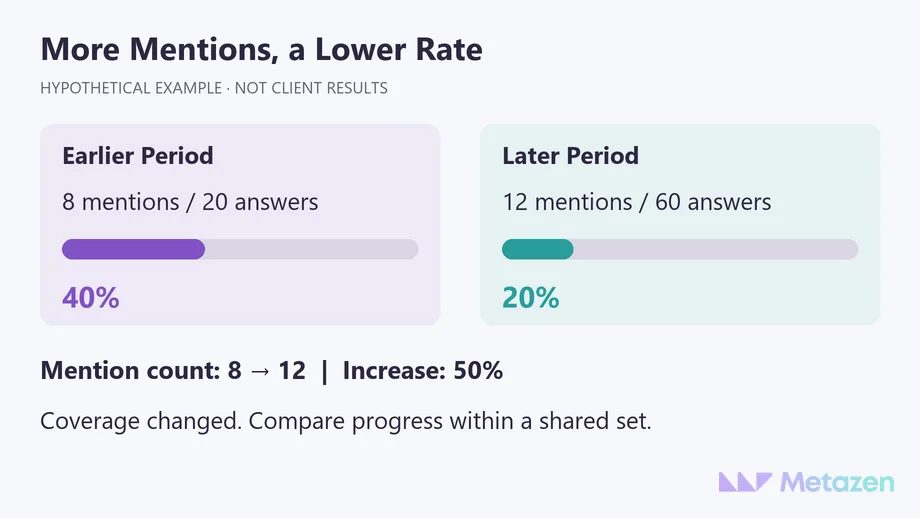
Do not immediately label the lower rate a failure either. The later period might include harder questions or additional platforms. Request a comparison of the prompts and platforms present in both periods. Show newly added coverage separately. If a prompt was rewritten, retain its earlier version rather than silently treating it as unchanged.
The comparison notes should identify failed data collection, changes to the tool’s method and relevant site updates. A technical failure to obtain an answer is different from a completed answer that does not mention the brand. Semrush’s index methodology presents platforms separately because aggregation can conceal their differences.
A page update and a visibility increase happening in the same period do not prove that the update caused the increase. Keep completed work, observed results and the proposed explanation separate. An explanation still awaiting evidence should remain a hypothesis.
4. Are Visibility and Business Outcomes Kept Separate?
A brand mention, a citation, a website visit and a completed sale are different events. The report should not skip from the first to the last. If it claims more AI-sourced inquiries, ask how inquiries were counted, how the source was assigned and whether the sales team has assessed their quality.
| Report Claim | Explanation to Request | Does Not Establish |
|---|---|---|
| Visibility improved | Before-and-after results within consistent coverage, with a metric definition | More sales |
| Our pages are cited | Platform data or saved answers with the exact cited URLs | A positive recommendation or a click |
| AI visits increased | The source filter, date range and session definition | The total audience that saw the answers |
| Inquiries increased | Counting rules, duplicate handling and inquiry quality | Collected revenue |
For Google, the Search Console generative AI performance report provides AI Overviews and AI Mode impression data across dimensions such as pages, countries, devices and dates. Impressions are not visits or sales. Its coverage should not be described as the results of every AI platform.
Analytics may lack clear source information for some visits. Google’s explanation of direct/none traffic lists several causes, so assigning all direct traffic to AI would be unjustified. Check the dimension behind a total as well: user, session and event scopes describe different parts of the customer journey.
5. Does the Next Action Have an Owner and Review Date?
“Improve the content” leaves the task unresolved. A more useful record would read: “Correct the opening hours on the maintenance service page. The content owner will confirm them with operations, check the published page and revisit the monitored answers on the agreed schedule.” When several pages have gaps, organize content findings by page and owner to establish the order of updates.
Acceptance should concern work the team can control. You can check that accurate information has been published; you cannot guarantee that every AI product will give the same answer by a chosen date. When evidence is weak, the first task may be to complete the record rather than create more content. Where a page needs editing, our approach to writing answers with evidence and clear limits can help define the work.
Close the meeting with three decisions: which findings you accept, which need clarification and who will act on each agreed task. The next report should return to unresolved questions. New charts do not resolve questions left unanswered month after month.
Turn Your GEO Findings into Work You Can Act On
If you have a report but are unsure which findings justify action, we can start by reviewing its coverage and evidence together. At Metazen, our software and digital marketing team considers technical access and content needs alongside the business goal. Explore the scope of our GEO and AEO service to see how we can support the review, improvement work and follow-up.

